How to Choose the Right Fertilizer for Your Plants: A Complete Beginner-to-Expert Guide for Healthy Growth
🌱 Introduction
One of the most common mistakes plant owners make is assuming that water and sunlight are enough to keep plants healthy. While these are essential, they are only part of the equation. The real secret behind thriving plants—whether indoor, outdoor, or bonsai—is proper nutrition.
Fertilizers provide plants with the essential nutrients they need to grow, develop strong roots, and resist diseases. However, choosing the right fertilizer can be confusing, especially with the wide range of options available on the market.
In this complete guide, we will break down everything you need to know about plant fertilizers—from understanding nutrients to selecting the right type for your specific plants—so you can achieve optimal growth and long-lasting health.
🌿 Why Fertilizers Are Essential for Plant Growth
Plants naturally absorb nutrients from the soil. However, in pots or controlled environments, these nutrients become depleted over time. Without replenishment, plants begin to show signs of stress:
- Yellowing leaves
- Slow or stunted growth
- Weak stems
- Poor flowering or fruit production
Fertilizers act as a supplement, restoring essential nutrients and ensuring that plants can perform vital processes such as photosynthesis and root development.
🧪 Understanding the Basics: NPK Explained
Every fertilizer is defined by three key nutrients:
- Nitrogen (N)→ promotes leaf and stem growth
- Phosphorus (P)→ supports root development and flowering
- Potassium (K)→ strengthens plant immunity and overall health
This is commonly referred to as the NPK ratio, and it is one of the most important factors when choosing a fertilizer.
Examples:
- 10-10-10 → balanced fertilizer
- 20-10-10 → growth-focused (more nitrogen)
- 5-10-10 → flowering-focused
Understanding NPK is the first step toward selecting the right product.
🌿 Types of Fertilizers: Which One Should You Choose?
There are several types of fertilizers available, each with its own advantages.
💧 1. Liquid Fertilizers
Liquid fertilizers are one of the most popular choices, especially for indoor plants.
Advantages:
- Fast absorption
- Easy to apply
- Immediate results
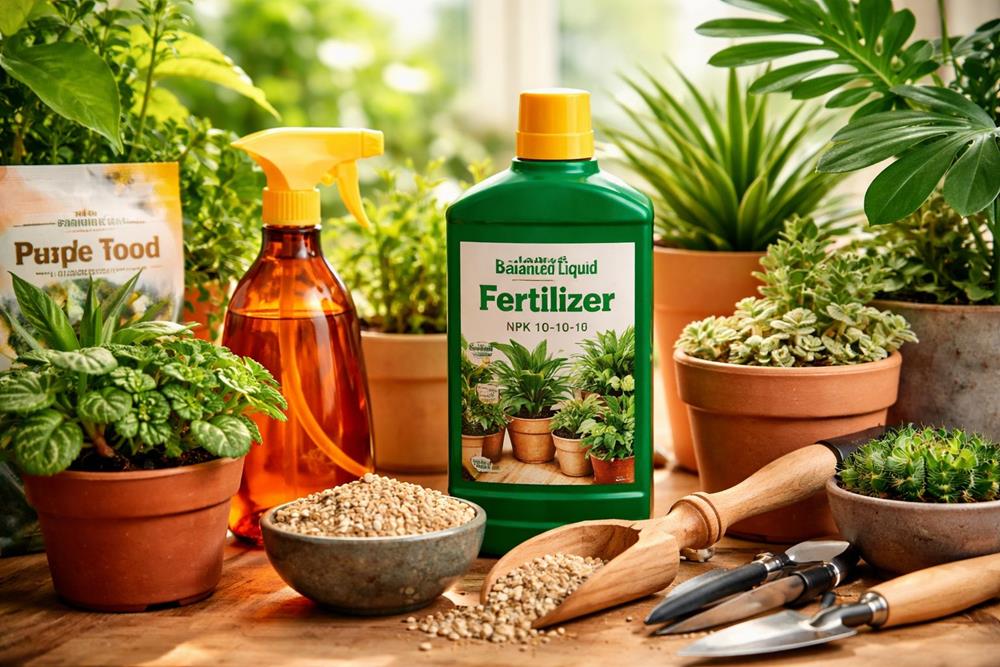
👉 A balanced liquid fertilizer is ideal for beginners, as it provides all essential nutrients in the right proportions.
🌱 2. Granular Fertilizers
These fertilizers are applied directly to the soil and release nutrients slowly over time.
Advantages:
- Long-lasting
- Less frequent application
- Ideal for outdoor plants
🌿 3. Organic Fertilizers
Derived from natural sources such as compost, manure, or plant-based materials.
Advantages:
- Eco-friendly
- Improves soil structure
- Supports beneficial microorganisms
⚗️ 4. Synthetic Fertilizers
Chemically formulated to provide precise nutrient levels.
Advantages:
- Highly effective
- Controlled nutrient ratios
- Quick results
🌍 Choosing the Right Fertilizer Based on Plant Type
Different plants have different nutritional needs. Choosing the wrong fertilizer can do more harm than good.
🪴 Indoor Plants
Indoor plants require a balanced and controlled nutrient supply.
Best choice:
- Balanced liquid fertilizers
- Low concentration, frequent application
👉 For a deeper understanding of indoor plant nutrition and care, you can explore a complete indoor plant care guideprovided by Bioges & Co.
🌳 Outdoor Plants
Outdoor plants often benefit from slow-release fertilizers.
Best choice:
- Granular fertilizers
- Organic compost
🌸 Flowering Plants
These plants need more phosphorus to support blooming.
Best choice:
- Fertilizers with higher P values
🌿 Bonsai Plants
Bonsai require precise nutrition due to their limited soil volume.
Best choice:
- Liquid fertilizers
- Controlled dosage
- Frequent monitoring
⚠️ Common Fertilization Mistakes
Even experienced gardeners make mistakes when it comes to fertilizing.
❌ Over-fertilizing
Too much fertilizer can burn roots and damage plants.
Signs:
- Brown leaf tips
- Salt buildup in soil
- Wilting despite watering
❌ Using the Wrong Type
Not all fertilizers are suitable for all plants.
❌ Ignoring Plant Growth Stage
Plants need different nutrients during different stages:
- Growth phase → more nitrogen
- Flowering phase → more phosphorus
❌ Inconsistent Application
Irregular fertilization leads to unstable growth.
🌿 How Often Should You Fertilize?
The frequency depends on the type of fertilizer and plant.
General guidelines:
- Liquid fertilizers → every 2–4 weeks
- Granular fertilizers → every 1–3 months
- Organic fertilizers → varies based on composition
Always follow product instructions and observe plant response.
🌱 Soil Health and Fertilization
Healthy soil is just as important as the fertilizer itself.
Good soil should:
- Drain well
- Retain moisture
- Contain organic matter
Fertilizers work best when combined with high-quality soil.
🌍 Organic vs Synthetic Fertilizers: Which Is Better?
There is no one-size-fits-all answer.
Feature | Organic | Synthetic |
Speed | Slow | Fast |
Sustainability | High | Moderate |
Control | Low | High |
Soil improvement | Yes | No |
👉 The best approach is often a combination of both.
🌿 Advanced Tips for Optimal Plant Growth
If you want to take your plant care to the next level, consider these advanced strategies:
🌡️ Monitor Environmental Conditions
Temperature, humidity, and light all influence nutrient absorption.
🧪 Adjust Fertilizer Based on Season
- Spring/Summer → active growth → more nutrients
- Autumn/Winter → reduced growth → less fertilization
💧 Combine Fertilization with Proper Watering
Nutrients are absorbed through water, so watering and fertilization must work together.
🔍 Observe Your Plants
Your plants will always tell you what they need.
🌿 The Role of Fertilizers in Sustainable Gardening
Using fertilizers responsibly contributes to a more sustainable environment:
- Reduces waste
- Promotes efficient plant growth
- Minimizes environmental impact
Choosing the right products and applying them correctly helps maintain ecological balance.
🪴 Building a Simple Fertilization Routine
For beginners, simplicity is key.
Step-by-step:
- Choose a balanced fertilizer
- Start with a low dosage
- Apply regularly
- Monitor plant response
- Adjust as needed
🌱 Why Nutrition Is the Key to Long-Term Plant Health
Healthy plants are not just the result of good lighting or watering—they are the result of proper nutrition.
Fertilizers:
- Strengthen plant structure
- Improve resistance to pests
- Enhance growth and appearance
Ignoring fertilization is one of the main reasons plants fail to thrive.
✅ Conclusion
Choosing the right fertilizer is one of the most important steps in successful plant care. By understanding nutrients, selecting the right type, and applying it correctly, you can transform your plants from average to thriving.
Whether you are caring for indoor plants, outdoor gardens, or bonsai, proper fertilization will always play a crucial role in achieving healthy, vibrant growth.
🔗 About biogesandco
If you want to deepen your knowledge about fertilizers, plant nutrition, and advanced gardening techniques, biogesando offers a wide range of resources designed for both beginners and experienced growers. From understanding nutrient balance to selecting the right products, the platform provides practical insights to help you achieve the best results with your plants.